

DevOps Course in Nagpur: Learn Industry-Ready DevOps Skills
DevOps Course in Nagpur helps students and working professionals build the skills needed for modern software development and IT operations. Technology is changing rapidly, and companies are looking for professionals who can build, test, deploy, and maintain applications faster than ever. This guide explains DevOps, the tools you’ll learn, career opportunities, salary, certifications, and how to start a successful career in this field.
If you’re planning to build a career in IT, joining a DevOps Course in Nagpur can be one of the smartest decisions. Whether you’re a student, graduate, working professional, or someone looking for a career switch, learning DevOps can open doors to high-paying job opportunities.
This guide explains everything you need to know about DevOps, what you’ll learn, career opportunities, salary, and why it’s becoming one of the most in-demand skills worldwide.
What is DevOps?
DevOps is a modern software development approach that brings developers and IT operations teams together. Instead of working separately, both teams collaborate throughout the software development lifecycle.
The main objective of DevOps is to deliver software quickly, improve quality, reduce deployment failures, and automate repetitive tasks.
Today, almost every technology company uses DevOps practices because they improve productivity, scalability, and customer satisfaction.
Why Learn DevOps?
The demand for DevOps professionals continues to increase because businesses want faster software delivery without compromising quality.
Some major reasons to learn DevOps include:
- Faster career growth
- Excellent salary packages
- High industry demand
- Global career opportunities
- Automation skills
- Cloud computing integration
- Better collaboration between development and operations teams
- Continuous learning opportunities
Learning DevOps also gives you exposure to modern technologies like Cloud Computing, Containers, Infrastructure Automation, and CI/CD pipelines.
What Will You Learn in a DevOps Course?
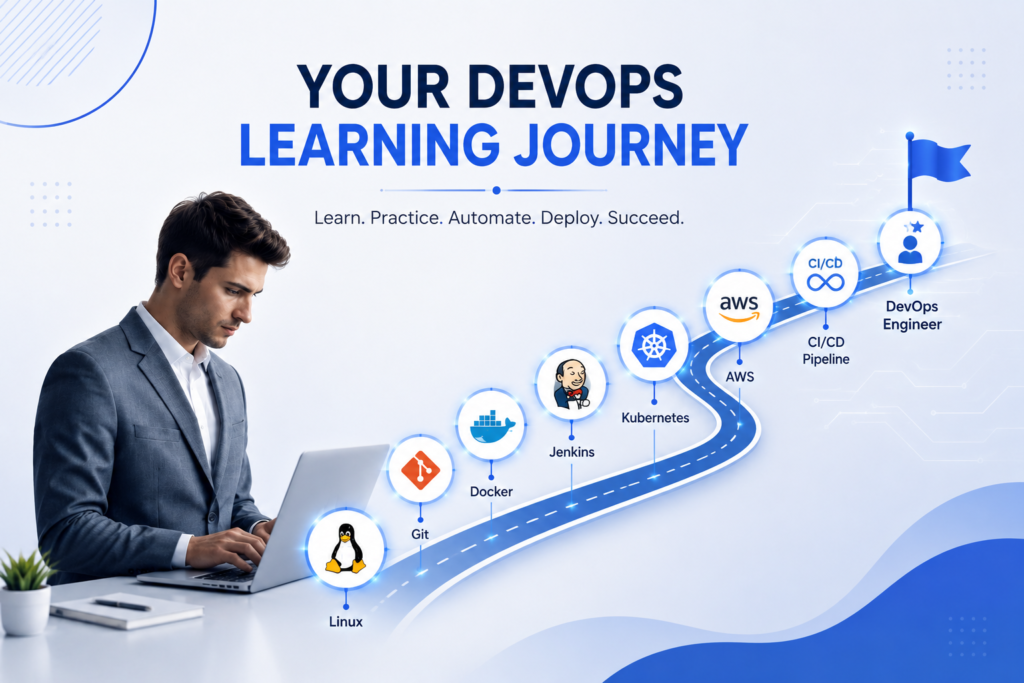
A DevOps course helps you understand how modern software is developed, tested, and deployed in IT companies. It starts with the basics of DevOps and gradually introduces you to the tools and technologies that are commonly used by industry professionals. You will learn important concepts such as Linux, Shell Scripting, Git & GitHub, Jenkins, Docker, Kubernetes, AWS Cloud Basics, Terraform, Ansible, CI/CD Pipelines, Monitoring Tools, Infrastructure Automation, and Real-Time Project Deployment.
Along with learning the theory, you will also get hands-on experience by working on practical exercises and real-world projects. This practical approach helps you understand how different DevOps tools work together to automate software development and deployment. It also improves your problem-solving skills and prepares you to handle real workplace challenges.
By the end of the course, you will have the knowledge and confidence to build, automate, test, and deploy applications using industry-standard DevOps practices. Since these skills are used by startups, software companies, and multinational organizations, you will be well-prepared for job opportunities and a successful career in the IT industry.
Why is DevOps Becoming So Popular?
Today, companies regularly update their websites, mobile apps, and software to add new features and improve their services. Doing all these tasks manually takes a lot of time and increases the chances of mistakes. DevOps makes this process easier by helping teams automate many of these tasks.
DevOps also improves the way developers and IT operations teams work together. It helps them build, test, and deploy software faster and more efficiently. As a result, companies can release new updates quickly, fix problems sooner, and provide a better experience for their users.
As more businesses move towards cloud computing and automation, the need for DevOps professionals continues to grow. Companies are looking for people who have DevOps skills because they help save time, reduce errors, and improve productivity. This is why DevOps has become one of the most popular and in-demand career choices in the IT industry.
Who Should Join a DevOps Course?
A DevOps course is suitable for learners from different educational and professional backgrounds.
Ideal Candidates
- Engineering students
- BCA & MCA students
- B.Sc. IT graduates
- Computer Science students
- Software Developers
- Manual Testers
- Automation Testers
- System Administrators
- Cloud Engineers
- Freshers
- Working Professionals
- Career Switchers
Even if you’re starting from scratch, consistent practice can help you master DevOps concepts.
Essential DevOps Tools You'll Master
During training, you’ll gain hands-on experience with industry-standard tools.
- Git & GitHub- Version control helps developers manage source code efficiently while enabling collaboration across teams.
- Jenkins- Automates software building, testing, and deployment processes
- Docker- Creates lightweight containers that package applications with all required dependencies.
- Kubernetes- Manages containerized applications at scale and automates deployment.
- Terraform- Automates infrastructure creation across multiple cloud platforms.
- Ansible- Simplifies server configuration and application deployment through automation.
- AWS- Provides cloud services that support hosting, deployment, storage, networking, and scalability.
Benefits of Learning DevOps
Learning DevOps offers many benefits for both your technical skills and your career. During the course, you will learn how to automate tasks, manage servers, and deploy applications more efficiently. You will also gain knowledge of cloud computing, container technologies like Docker and Kubernetes, and Continuous Integration and Continuous Deployment (CI/CD). These skills help you work faster, reduce errors, and make software development more reliable.
Apart from technical knowledge, DevOps also provides excellent career benefits. As more companies adopt DevOps practices, the demand for skilled professionals continues to grow. This creates better job opportunities, higher salary packages, and the chance to work with leading companies in India and abroad. You can also explore freelancing opportunities and build valuable practical experience by working on real-world projects.
Learning DevOps not only improves your technical expertise but also helps you grow professionally. With industry-recognized skills and hands-on experience, you become more confident and job-ready. As you gain experience, you can take on bigger responsibilities, earn promotions, and build a successful long-term career in the IT industry.
Career Opportunities After Learning DevOps
DevOps professionals are hired across various industries.
Popular job roles include:
- DevOps Engineer
- Cloud Engineer
- Site Reliability Engineer (SRE)
- Build & Release Engineer
- Automation Engineer
- Infrastructure Engineer
- Platform Engineer
- CI/CD Engineer
- AWS Cloud Engineer
- Kubernetes Administrator
Many professionals also move into Cloud Architecture and DevSecOps after gaining experience.
Why Practical Training Matters
In today’s IT industry, learning only the theory is not enough to build a successful career. Companies prefer candidates who have practical knowledge and can confidently use DevOps tools in real-world situations. Hands-on experience helps you understand how different technologies work together and prepares you to solve real business challenges.
A good DevOps training program focuses on practical learning through live projects, real deployment scenarios, cloud-based practice, and hands-on lab sessions. It also provides interview preparation, resume-building support, mock interviews, and placement assistance to help students become job-ready. These activities allow you to apply what you have learned and gain confidence before entering the workplace.
Practical training not only improves your technical skills but also makes you more confident during job interviews and technical assessments. By working on real projects and industry-based tasks, you develop the experience that employers value, giving you a better chance of securing a rewarding career in the IT industry.
How Long Does It Take to Learn DevOps?
The learning duration depends on your consistency and prior technical knowledge.
A typical roadmap looks like this:
Stage 1 – Basics
- Linux
- Networking
- Git
- Shell Scripting
Stage 2 – Intermediate
- Docker
- Jenkins
- CI/CD
- AWS
Stage 3 – Advanced
- Kubernetes
- Terraform
- Ansible
- Monitoring
- Real-Time Projects
With regular practice, learners can become industry-ready within a few months.
How to Choose the Best IT Training Institute?
Finding the Best Training Institute in Nagpur for a Successful IT Career the institute offers:
- Updated DevOps curriculum
- Industry-certified trainers
- Practical lab sessions
- Real-world projects
- Placement support
- Mock interviews
- Resume preparation
- Flexible batch timings
- Certification guidance
- Lifetime access to learning resources.
Choosing the best IT training institute in Nagpur ensures you receive quality education along with the practical exposure required by recruiters.
Frequently Asked Questions (FAQs)
Is DevOps difficult for beginners?
With proper guidance, structured learning, and regular practice, beginners can learn DevOps successfully.
Do I need coding knowledge before learning DevOps?
Basic programming knowledge is helpful but not mandatory. Most institutes teach the required fundamentals.
Which cloud platform is used in DevOps?
AWS is the most commonly taught cloud platform, although Azure and Google Cloud are also widely used.
Is DevOps a good career in 2026?
Yes. DevOps remains one of the fastest-growing IT domains with strong demand across industries.
Can freshers get DevOps jobs?
Freshers with practical skills, certifications, and project experience can apply for entry-level DevOps roles.
What is the average duration of a DevOps course?
Most training programs are completed within 3–6 months, depending on the curriculum and learning pace.
Conclusion
DevOps has become one of the most valuable skills in today’s technology-driven world. Whether you’re a beginner or an experienced IT professional, learning DevOps can significantly improve your career prospects.
A well-designed DevOps Course in Nagpur helps you build practical skills, work on real-world projects, understand automation, cloud computing, CI/CD, containers, and deployment strategies used by modern companies.
If you’re serious about building a successful career in IT, now is the right time to enroll in a DevOps Course in Nagpur and start your journey toward becoming a highly skilled DevOps professional.
